Product Description
2023.Wolters Kluwer Lippincott 2 Edition _x000D_
About the Clinical Editors_x000D_
_x000D_
Juli C. Maxworthy, DNP, MSN, MBA, RN, CNL, CPHQ, CPPS, CHSE, FNAP, FSSH, is an Associate Professor at the University of San Francisco, School of Nursing and Health Professions, and President (2021) of the Society for Simulation in Healthcare._x000D_
_x000D_
Chad A. Epps, MD, FSSH, was the Executive Director, Center for Healthcare Improvement and Patient Simulation (CHIPS) and Professor at the University of Tennessee Health Science Center, and Past President of The Society for Simulation in Healthcare._x000D_
_x000D_
Yasuharu Okuda, MD, FACEP, FSSH, is Executive Director of the Center for Advanced Medical Learning and Simulation, CEO of USF Health Professions Conferencing Corporation, Associate Vice President, USF Health Office of Interprofessional Education and Practice, Professor of Medicine at the Morsani College of Medicine at the University of South Florida Health in Tampa, and President (2022) of the Society for Simulation in Healthcare._x000D_
_x000D_
Mary Elizabeth (Beth) Mancini, RN, Ph.D., NE-BC, FAHA, ANEF, FAAN, is Professor Emeritus at the College of Nursing, the University of Texas at Arlington. She is also a Past President of The Society for Simulation in Healthcare._x000D_
_x000D_
Janice C. Palaganas, Ph.D., APRN, ANEF, FNAP, FAAN, FSSH, is a Professor at MGH Institute of Health Professions, Lecturer at Harvard Medical School, Chief Executive Officer of the Institute for Interprofessional Innovations, and Principal Faculty at the Center for Medical Simulation at Massachusetts General Hospital, and in the Department of Anesthesia, Critical Care & Pain Medicine at Harvard Medical School in Boston._x000D_
_x000D_
5-Star Review from Doody's Review Service. _x000D_
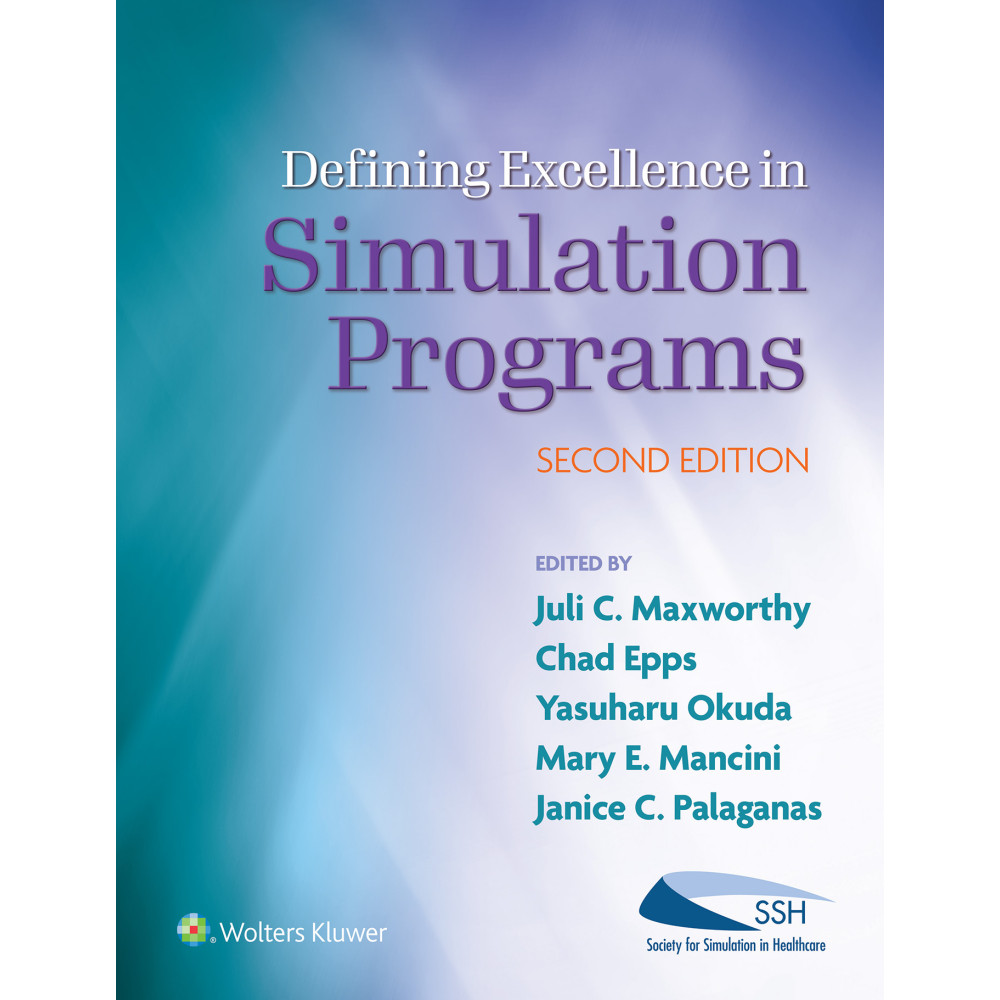
Raise your simulation programs to new heights with the fully updated Defining Excellence in Simulation Programs, 2nd edition. An official publication of the Society for Simulation in Healthcare, this fully illustrated guide speaks to the needs of all healthcare professionals using simulation for education, assessment, and research. Offering best practices for a wide variety of programs, it addresses all areas of program management, from staffing, funding, and equipment, to education models. Whether you are new to running a simulation program, developing a program, or studying simulation, this is your key to creating cost-effective, research-based programs. _x000D_
_x000D_
Improve your simulation program with this definitive guide. This edition offers: _x000D_
•NEW content on International Nursing Association for Clinical Simulation (INACSL) and Association of Standardized Patient Educators (ASPE) standards of practice _x000D_
•17 new chapters, with content reorganized to better align with certification exam blueprints _x000D_
•A fully illustrated, comprehensive framework for all operational aspects of simulation programs _x000D_
•Sections that address:_x000D_
•Standards of Practice – SSH, INACSL, and ASPE standards, technology standards, ethics, and more _x000D_
•Simulation Modalities – History of modern-day mannequins; mannequin terminology, selection, and usage; and standardized patient/participant _x000D_
•Simulation Methods – In situ, mobile, hybrid, and tabletop simulation; and the continuum of care _x000D_
•Management – Creating the infrastructure for a successful program, business needs and assets management, policies and procedures, and strategic plans _x000D_
•Funding – Sources of revenue, program budgets, business plans, and fee structures _x000D_
•Environmental Design – Building a simulation center, technical infrastructure, and more _x000D_
•Educational and Content Development – Educator training and simulation methodology courses, assessing learning needs, shared theories, and more _x000D_
•Delivery of Simulation – Assessment in healthcare simulation, preparing the learner, management of the scenarios, and more _x000D_
•Research – Healthcare simulation research, institutional review board, and more _x000D_
•Resources – Terms of references, examples of studies, case and scenario development templates, and more _x000D_
• Chapter features include: _x000D_
•Expert's Corner – Commentary on essential areas of training, research, and program development by simulation experts and founders _x000D_
•Consider This – Practical how-to's on critical, related topics _x000D_
•Example and Case Study Boxes – Added examples that support chapter content _x000D_
•Terms of Reference – Defines simulation terms and concepts